Control a door opener with your smartphone: modern access control via smartphone
Control door openers with your smartphone: BLE/NFC via app. Quick to retrofit, GDPR-compliant, VDE-certified.


Smartphone-based access control is revolutionizing how we open doors and manage access. If you want to control a door opener with your phone, you need a compatible electronic locking unit, such as a cylinder, smart door handle, or wall reader, as well as a suitable smartphone app to manage digital keys. Verification and door unlocking are then handled via Bluetooth Low Energy (BLE) or NFC, without the need for a mechanical key. This technology not only provides securely encrypted access that can be controlled at any time, but it can also be easily retrofitted to existing doors. You can conveniently assign access rights via a web portal or an app.
Switching to mobile access control offers far more than just increased convenience: cryptographically protected permissions significantly enhance security and enable much more flexible management than conventional key systems, an essential advantage in times when access rights often need to be adapted.
How does a smartphone door opener work?
Digital access solutions replace the traditional key with an electronic permission stored on the mobile phone; a digital key. The opening process is simple: the smartphone communicates via BLE or NFC with the installed locking unit, which then cryptographically verifies the permission. If valid, the door is unlocked.
Compared to traditional keys, this technology offers decisive advantages: permissions can be time-limited, tied to specific times of day, or revoked remotely at any time. Communication between the mobile phone and the locking unit uses standardized protocols and is protected by modern encryption methods that effectively prevent unauthorized interception or manipulation of signals.
The most important building blocks
- Locking unit: Electronic cylinders, smart door handles, or wall readers for electric door openers, gates, barriers, and elevators. These hardware components replace classic lock cylinders or extend existing electric door opener systems.
- Digital keys: Time- and location-defined permissions tied to individuals or roles that can be customized individually. They can be activated or deactivated automatically, without any physical exchange.
- App and/or web portal: These interfaces enable the distribution, adjustment, and revocation of access, individually, in larger groups, or fully automated. Management takes place in real time and integrates seamlessly into existing workflows.
- Cloud service: Handles centralized management, logging, and integration with third-party systems. BlueID operates a highly secure Trusted Cloud Service to ensure maximum availability and data protection.
- Interfaces: APIs and SDKs enable integration into your own apps, HR tools, or booking platforms and ensure seamless embedding of the access system into existing processes and software environments.
Bluetooth, NFC, and offline capability working together
- Bluetooth Low Energy (BLE): This technology stands out for its user-friendliness, energy efficiency, and short-range performance, ideal for convenient, hands-free opening with the phone in your pocket using a proximity function. The range can be configured from a few centimeters to several meters depending on the use case, ensuring high convenience with robust security.
- NFC: Enables close-range authentication via a simple tap. This method is particularly suitable for turnstiles or wall readers in entrances. The extremely short range of only a few centimeters ensures controlled interaction and prevents unintentional opening.
- Offline unlocking: The digital key is securely stored on the device, allowing doors to be opened even without an active mobile connection. The system synchronizes automatically later. This guarantees readiness even in areas with poor coverage, such as underground garages or remote parts of buildings.
Retrofit an electric door opener with a smartphone: quickly and cleanly
Retrofitting an electric door opener with smartphone control is usually feasible without extensive conversion work. The optimal solution depends on the door type, security requirements, and structural conditions. Modern retrofit solutions are designed to be installed with minimal impact on the building structure and to operate reliably on both interior doors and weather-resistant exterior doors. Expert consultation helps identify the ideal solution for each door, technically optimal and aesthetically in line with the building.
Common retrofit paths
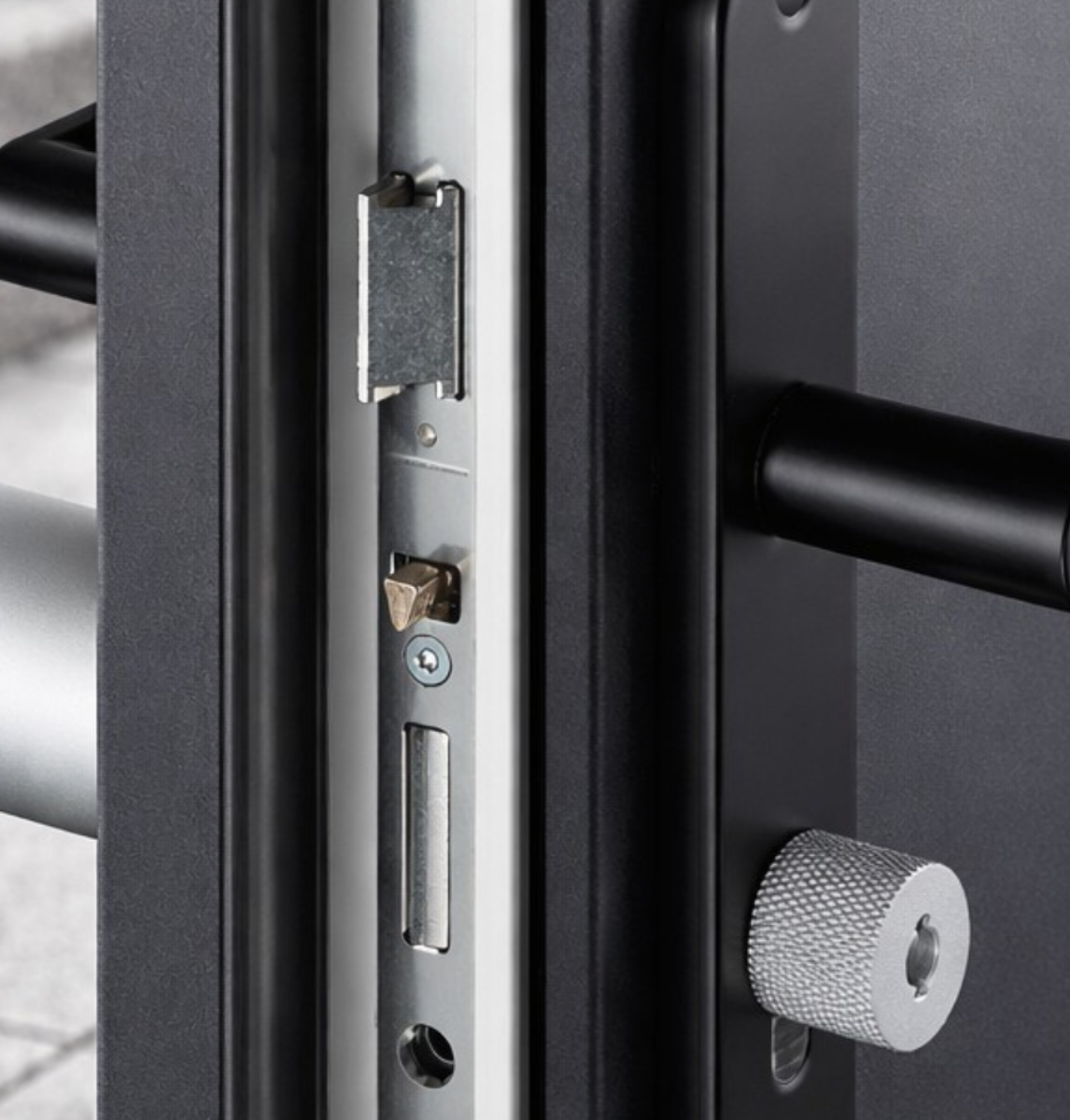
- Electronic cylinder: Replaces the classic cylinder and operates entirely on batteries, with no wiring. This solution is particularly suitable for existing buildings. Installation typically takes only 15–20 minutes per door and requires neither special electrical installations nor complex cabling. Modern electronic cylinders blend seamlessly with existing door fittings and do not affect the appearance.
- Smart door handle: This variant integrates the necessary electronics directly into the door fitting and provides an elegant solution for interior and exterior doors. It impresses with its attractive design and is particularly suitable when the entire door fitting is to be modernized. Available in various versions, the handle can be perfectly adapted to the building’s architecture and appearance.
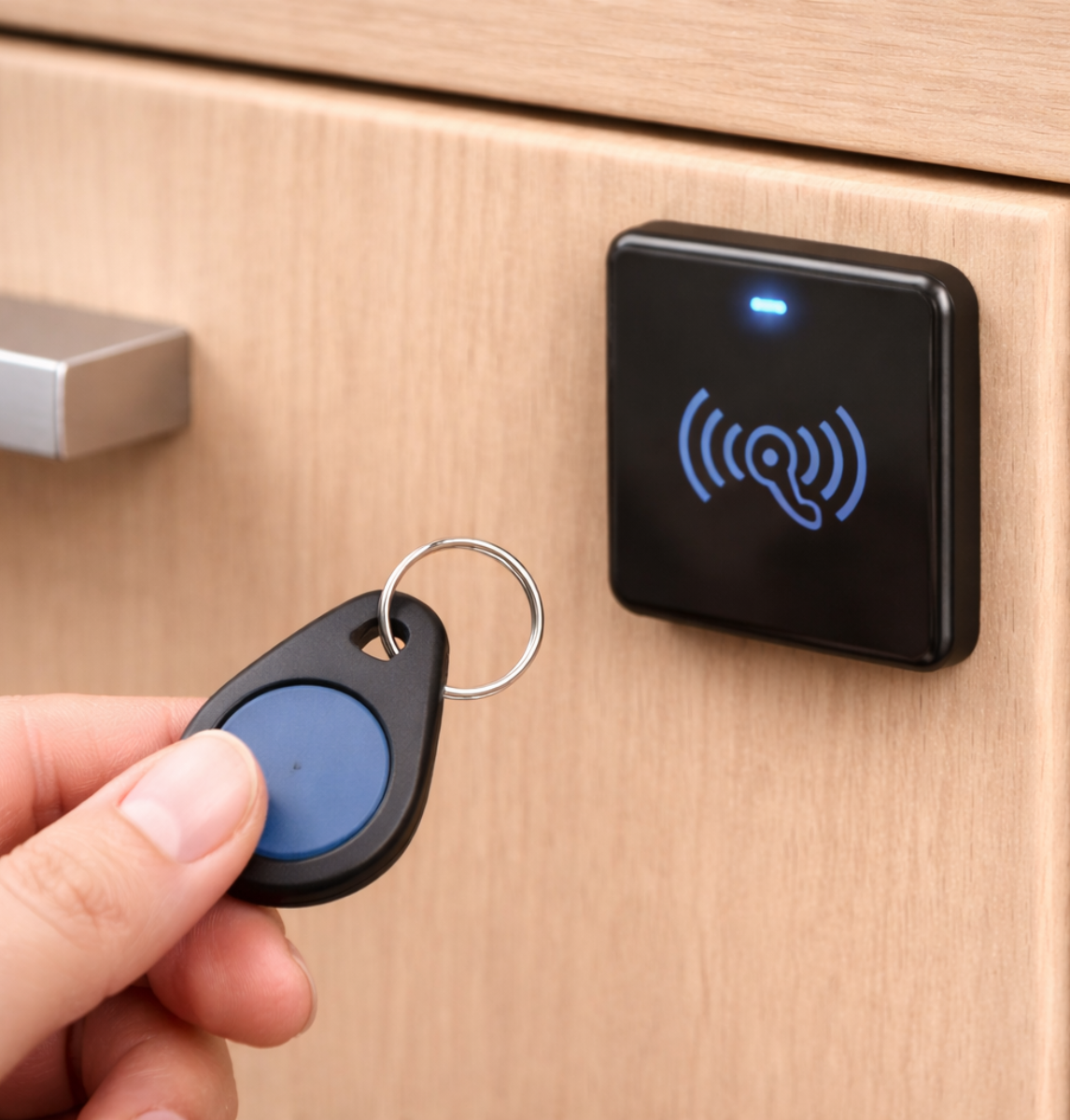
- Wall reader with relay: This component controls existing electric door openers, motor locks, barriers, or elevators and is ideal for main entrances and outdoor areas. This flexible solution is compatible with almost all electric opening mechanisms and can be easily integrated into existing building management systems.
Step-by-step to the smartphone-controlled door
- Assessment: First, conduct a careful analysis of the door type, lock, cylinder size, user groups, and access scenarios. This thorough assessment forms the basis for selecting the optimal hardware and helps identify potential challenges early on.
- Select hardware: Next, choose the appropriate hardware, cylinder, handle, or wall reader, based on the intended use. Factors such as weather resistance, battery life, and specific security requirements play a key role.
- Installation: Components are usually installed with just a few steps and without special tools. Most elements can be installed with standard tools and do not require structural changes to the door.
- Commissioning: After physical installation, set up the app or web portal. Users are created and digital keys assigned. Software configuration can be done in parallel with hardware installation, so the system is ready to use immediately after mounting.
- Testing & training: Finally, conduct comprehensive on-site tests, provide a brief introduction for administrators and users, and define fallback procedures for exceptional situations. Real-world testing ensures all functions work flawlessly and users become familiar with the system.
Advantages of retrofitting
- No more key copies, no cylinder replacement in case of loss, resulting in significant cost savings and increased security
- Flexible rights assignment within seconds, including temporary access for service providers or visitors, which noticeably speeds up administrative processes
- Scalability from a single door to an entire campus, allowing the system to grow with increasing requirements
- Low operating costs thanks to battery operation and efficient cloud management, significantly reducing total cost of ownership (TCO) compared to conventional systems
Door opener smartphone app: features for operators and users
With a professional smartphone door opener app, you manage the entire lifecycle of access rights, centrally, securely, and with complete traceability. The user experience is designed to be intuitive for all user groups and supports both comprehensive administrator functions and easy handling for end users. Regular updates deliver new features and ensure compatibility with current operating systems.
For administrators and operators
- Assign rights in seconds: Individual, group-, and role-based rights with definable start and end dates can be configured via a clear dashboard that presents all relevant information at a glance.
- Visitor management: Temporary access is sent easily via email or link and activates automatically at the specified time, deactivating by itself after expiration. This greatly relieves front desk staff and enables a seamless visitor process.
- Self-service & automation: Seamless integration into existing HR systems via SCIM or API enables automated onboarding and offboarding. This significantly reduces manual effort and minimizes potential sources of error.
- Logs & audit: The platform precisely documents who had which permission and when. This GDPR-compliant view of all access events ensures complete traceability in the event of security incidents.
- Emergency and fallback concepts: The system offers real-time rights revocation, reliable offline functionality, and various multifactor options. Functionality is maintained even in exceptional situations, without compromising security.
For end users
- Open doors via smartphone, either by opening the app or using the convenient proximity function (e.g., near-by function). The intuitive operation requires no special training.
- Clear overview of all authorized doors, including important notes such as time restrictions. Users can see at a glance which doors they can open with their digital key.
- Alternative media: If needed, NFC cards or practical key fobs are available for times when the smartphone isn’t at hand. These backup options add flexibility and increase overall user acceptance.
User-friendly design for maximum adoption
The user interfaces of modern door opener apps have been optimized through extensive usability testing to ensure intuitive operation. Even users without technical knowledge can get started immediately without training. Clear visualization of doors and permissions, combined with well-designed visual and haptic feedback, drives high acceptance across all age groups.
Security and data protection: what really matters
Access control is highly security-critical, which is why BlueID uses proven security mechanisms and certified processes. Its multi-layered security architecture protects every part of the system, from hardware and communication channels to cloud infrastructure, with PKI-based end-to-end encryption, VDE certification, and a trusted AWS cloud environment.
Data is processed according to strict GDPR principles, using only the minimum necessary information. BlueID supports anonymized identities as well as integration with enterprise identity providers via OpenID/SCIM. Granular logging and role-based access controls ensure full traceability and prevent unauthorized access.
Multiple complementary security layers—including tamper-protected hardware, encrypted communication, secure development practices, and continuous monitoring—ensure that even if a single layer were compromised, the overall system remains secure.

NFC smartphone door opener vs. Bluetooth: what fits your use case?
Both technologies offer a high level of security. The key difference lies in the user experience and infrastructure requirements. The optimal choice depends on the site-specific conditions, expected user behavior, and structural framework. In many installations, both methods are combined to leverage their respective strengths.
- NFC smartphone door opener:
This technology relies on the tap-to-unlock principle at the reader. It is particularly intuitive in entrance areas, airlocks, and at turnstiles. It’s also useful when smartphones should be intentionally taken out of a pocket. The very short range of just a few centimeters provides added safety at high-traffic entrances or in particularly sensitive areas. - Bluetooth Low Energy:
Offers high convenience, especially at doors that are frequently used, if desired, completely hands-free upon approach. This solution is ideal for office corridors, side and service doors. The individually configurable range enables convenience features like automatic opening on approach as well as precise distance control for security-critical zones. - Combined solution:
In many environments, a combination of BLE at office doors and NFC at main entrances has proven effective. BlueID supports both technologies, supplemented by classic NFC transponders as a reliable fallback. This hybrid approach combines optimal user comfort with situational security and provides maximum flexibility in everyday use.
Detailed technology comparison
Note on wallet integration:
Depending on project-specific requirements, smartphone wallets can be integrated into modern access systems. BlueID is continuously expanding its ecosystem in this direction to further optimize usability. Integration with Apple Wallet or Google Wallet adds convenience by enabling access without a separate app.
Operating a door opener with a smartphone: practical examples from various industries
Mobile access solutions are used across many industries, offering tailored benefits for each environment. In office buildings, they automate onboarding, visitor access, and room or parking management while reducing administrative work. In residential complexes, residents can open doors via app and grant temporary access to service providers, improving both security and convenience. In hotels, mobile keys speed up check-in, reduce queues, and enhance the guest experience with pre-arrival access. Clubs and educational institutions benefit from flexible access schedules and easy permission management, eliminating the cost and hassle of lost keys—especially useful for locations with frequently changing staff.
Integration and operations: how to future-proof your system
A modern access system should not be viewed in isolation, but as an integral part of the overall building and IT infrastructure. BlueID offers comprehensive integration capabilities that enable seamless embedding into existing and future systems.
- APIs and SDKs:
Use these tools to integrate mobile access functions seamlessly into your own app, supported are native SDKs (e.g., for iOS/Android) as well as plugins (e.g., for Flutter or React Native). Extensive documentation and numerous sample implementations significantly shorten development time. - System integration:
Automate the entire access and identity management by connecting to HR tools, OpenID, and SCIM. This integration significantly relieves both IT and facility management teams. Standardized interfaces enable a high degree of automation, reducing manual intervention to a minimum. - Scalability:
From a single door to distributed sites, new units can be added easily via rollout. The system grows flexibly with your requirements without fundamental architectural changes. - Efficient operations management:
Keep an eye on battery status, firmware updates, and permissions centrally. Service cases are rare, and required maintenance can be planned precisely. The clear management dashboard provides a comprehensive overview of system status and enables predictive maintenance.
Future-proof technology architecture
The BlueID platform has been designed from the ground up to be modular and future-oriented:
- Open standards: Consistent use of established protocols and interfaces instead of proprietary silos
- Regular updates: Continuous development and flexible adaptation to new technologies
- Backward compatibility: New features are implemented so that existing installations remain fully supported
- Edge computing: Decentralized intelligence in end devices minimizes dependence on central servers and increases resilience
This well-thought-out architecture ensures that your investment is protected in the long term and that the system remains compatible with future requirements and technologies.
Costs, TCO, and ROI: why smartphone access pays off
Switching to a digital access system with smartphone control is an investment at first. However, a total cost of ownership (TCO) view shows that this investment typically pays for itself within a few years and thereafter enables considerable savings compared to conventional systems.
- No key duplication and no cylinder replacement in case of loss.
A lost physical key can cost several thousand euros if locking systems need to be replaced. With digital keys, these costs are eliminated entirely. - Reduced administrative effort thanks to role concepts, automation, and self-service
Centralized management and extensive automation significantly reduce staff effort for key management, often by 70–80% compared to conventional systems. - Accelerated processes: onboarding, temporary access, visitor flows
Digitized processes speed up all access-related tasks and minimize waiting times and administrative downtime in day-to-day operations. - Higher security standards: no uncontrolled key circulation, complete rights management
The improved security architecture reduces potential damage from unauthorized access and can have a positive impact on insurance coverage.
Door opener smartphone app: what it must be able to do
A professional door opener app for smartphones combines rights management, secure key storage, convenient opening (via app, tap, or proximity), and precise logging. Particularly important are offline capabilities, an intuitive experience for users and administrators, and flexible integration into existing systems.
Key features of a high-quality solution include:
- Intuitive user interface: The app should be usable immediately with no training and provide clear visual cues for unambiguous door identification
- Reliable offline features: Doors must be openable securely at any time, even without an active internet connection
- High-grade encryption: The digital key must not be copyable or misusable even if the device is compromised
- Energy-efficient implementation: The app should have minimal impact on the smartphone’s battery life
- Thoughtful feedback: Visual and haptic feedback on opening status greatly improves usability
- Comprehensive accessibility: The app should be accessible to all user groups, including people with visual or hearing impairments
Retrofit an electric door opener with a smartphone: in-depth options
Whether an electronic cylinder, a smart fitting, or a wall reader with relay: there is a fitting retrofit solution for almost any door. BlueID supports all three variants, from apartment doors to exterior doors, including gates and elevators.
Electronic cylinder
The electronic cylinder is the simplest retrofit solution, as it directly replaces the existing mechanical cylinder. Advantages at a glance:
- Quick installation: Replacement takes 15–20 minutes without special tools
- No wiring required: The battery-powered solution is ideal for existing buildings
- Configurable security levels: Available in different protection classes (e.g., with SKG certification)
- Weather resistance: Suitable for interior and exterior doors, with reliable protection against moisture and temperature fluctuations
With normal use, battery life is typically two years, with timely low-battery warnings both in the app and directly on the cylinder via visual signals.
Smart door fitting
The smart door handle integrates the electronics directly into the fitting and offers an aesthetically pleasing solution for modern doors:
- Elegant design: High-quality stainless steel finish that blends seamlessly into modern architecture
- Straightforward installation: Replaces the existing fitting without structural changes to the door
- Integrated status display: LED signals reliably indicate opening status and battery level
- Suitable for fire doors: Special versions with corresponding approvals and certifications available
This solution is particularly suitable for representative areas where aesthetics and functionality are equally important.
Wall reader with relay
For electric door openers, barriers, or elevators, the wall reader is the optimal solution:
- Universal connectivity: Controls virtually all electric opening mechanisms
- Separated security zones: The reader is outside, the control electronics in the secured interior
- Flexible mounting options: Depending on structural conditions, both surface- and flush-mount installations are possible
- Efficiently extendable: Easy to combine with additional elements such as a keypad or fingerprint sensor
BlueID: the professional solution to control a door opener with your smartphone
BlueID delivers a comprehensive, field-proven, certified, and flexibly scalable package for smartphone-based access control:
- Locking units: Digital knob cylinders, modern door handles, and powerful wall readers, usable indoors and outdoors, made from high-quality components for maximum durability and reliability
- Access media: Smartphone (BLE), NFC transponders, and, prospectively, wallet integration; flexibly combinable depending on user group and specific use case
- Software: Clear web portal, modern mobile app with convenient near-by function, and detailed logs for complete documentation and straightforward administration
- Security architecture: PKI-based encryption, VDE-certified, GDPR-compliant, backed by a Trusted Cloud Service with the highest security standards
- Comprehensive integration: REST API, SDKs, OpenID/SCIM, ideal for PropTech applications, HR and booking systems, and flexible customization for individual requirements
If you want to retrofit an electric door opener with smartphone control or modernize an existing system, we support you from initial planning to final rollout, including individual configuration and rapid commissioning. Our expert team will advise you comprehensively to develop the optimal solution for your specific requirements.
Conclusion
A door opener controlled via smartphone significantly increases convenience, security, and efficiency, from a single property to a sprawling campus. With BlueID, you get a certified, privacy-compliant, and future-proof solution that integrates seamlessly into your existing processes and adapts flexibly to your individual requirements. The combination of high-quality hardware, well-designed software, and comprehensive services makes BlueID the first choice for professional access solutions in the digital age.
Request a personalized product demonstration today or have your specific project configured without obligation, our knowledgeable team will be happy to advise you and help you find the tailored solution for your individual requirements.
FAQ: Control a door opener with your smartphone
How secure is opening via smartphone?
Extremely secure. BlueID uses PKI-based end-to-end encryption, certified security processes, and a Trusted Cloud Service. Permissions can be revoked at any time, limited in duration, or assigned based on roles, ensuring maximum security.
Does the system work without an internet connection?
Yes, absolutely. The digital key is securely stored on the smartphone. Doors can be opened via BLE or NFC even without an active mobile connection; synchronization occurs automatically once a connection is restored.
What happens if the smartphone battery is dead?
Various backup options are available for this case. As a fallback, NFC cards or practical NFC key fobs can be used. Alternatively, individual emergency processes can be defined, for example via on-site property management.
Which smartphones are supported?
Current iOS and Android devices are fully compatible. For BLE openings, only an enabled Bluetooth module is required. NFC functionality varies by device and specific use case (app, transponder, or, prospectively, wallet integration).
Can I continue using my existing door opener?
In many cases, yes. With a wall reader and the appropriate relay, a previously installed electric door opener (electric strike, motor lock, or barrier) can be made smartphone-capable, without extensive modifications.
What is the main difference between NFC and Bluetooth for opening?
NFC is based on the tap-to-unlock principle at the reader, ideal for main entrances and turnstiles. Bluetooth enables convenient opening on approach, especially suitable for office and side doors. Many successful projects combine both technologies for an optimal user experience.
How do I manage access for visitors and external service providers?
Temporary access can be created within seconds and sent via link. You define start and end dates as well as precise time windows, fully transparent and traceable at any time.
Does BlueID comply with GDPR requirements?
Absolutely. BlueID consistently follows the data minimization principle, offers versatile options for anonymized identities, and supports modern standards like OpenID/SCIM for privacy-compliant user management.
What hardware options are available?
The portfolio includes electronic cylinders, smart door handles, and wall readers for doors, gates, elevators, or barriers. The right option for your needs depends on the door type, the place of use, and individual security requirements.
How do I start a specific project with BlueID?
Contact our team for a brief initial consultation to clarify your needs. You will then receive, on request, an individual configuration and an illustrative live demonstration.