RFID Furniture Locks: Modern Access Control for Cabinets and Lockers
RFID furniture locks for cabinets and lockers: Increase security and flexibility.

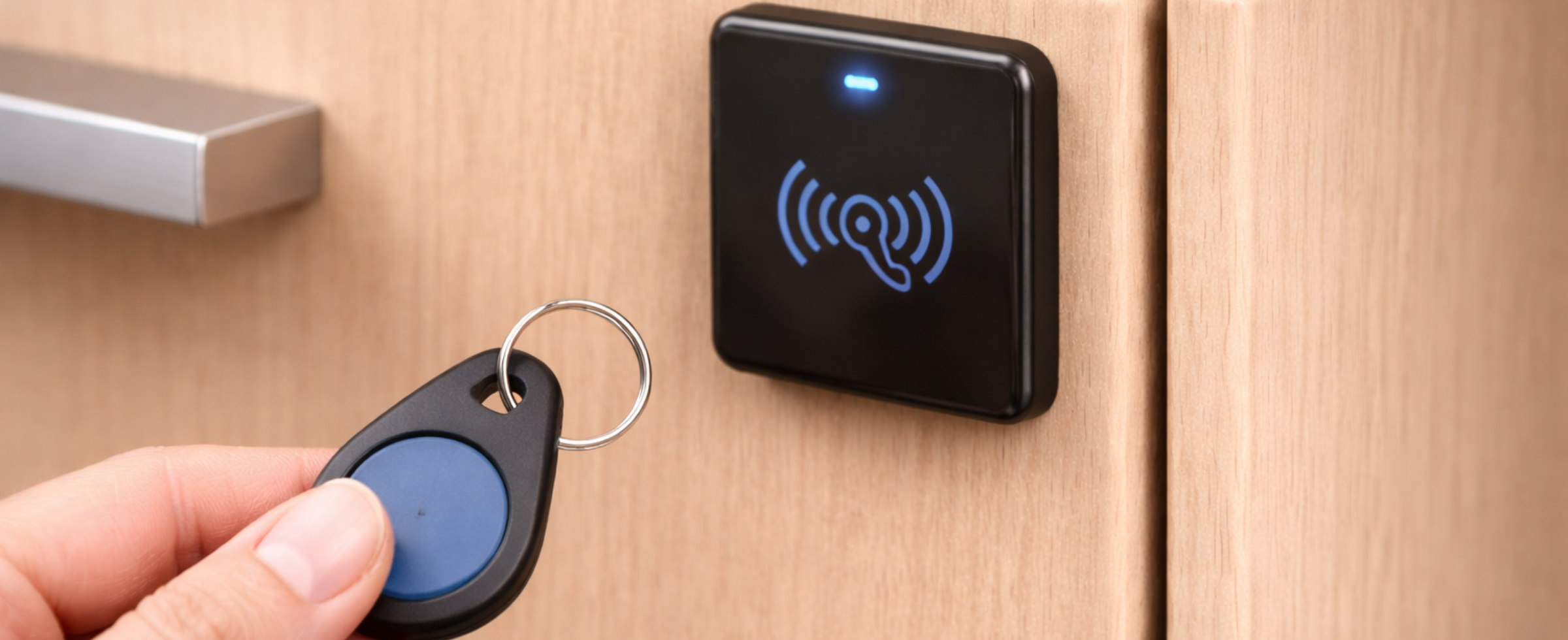
RFID furniture locks are revolutionizing how businesses, educational institutions, and public facilities secure their cabinets, lockers, and valuables compartments. These contactless locking systems combine the highest security standards with maximum user-friendliness and enable flexible, digital management of access permissions. Instead of traditional keys, authorized users employ transponders, smartphone apps, or smartcards to open their personal storage spaces quickly, securely, and without physical contact with the lock.
How RFID Furniture Locks Work in Detail
The technology behind RFID furniture locks is based on Radio Frequency Identification, a proven method for contactless data transmission using electromagnetic waves. At the heart of the system, three core components work together: the RFID reader in the furniture lock, the user’s identification medium, and a management software in the background.
When a user approaches the furniture lock with their transponder, the integrated RFID reader generates an electromagnetic field. This field activates the passive transponder, which then transmits its unique identification number. The reader compares this information with the stored permissions, a process that takes only fractions of a second. If authentication is successful, the lock unlocks automatically.
Communication range varies by frequency. Low-frequency systems at 125 kHz operate at a close range of a few centimeters, while high-frequency systems at 13.56 MHz, the standard for NFC applications span distances of up to 10 centimeters. These short ranges are deliberate and increase security by virtually eliminating unintended openings.
Advantages Over Mechanical Locking Systems
Switching from mechanical to RFID furniture locks offers numerous benefits that go far beyond modernization. The central management of all access permissions via software enables administrators to grant, modify, or revoke access in real time. If an employee loses their transponder, its permission is simply deactivated, eliminating the time-consuming and costly process of replacing locks and keys entirely.
Cost efficiency is particularly evident in larger installations. While mechanical keys are expensive to procure and require full lock replacement if lost, RFID transponders cost only a fraction. Temporary permissions can also be issued, ideal for visitors, interns, or time-limited projects.
Another decisive advantage lies in comprehensive logging. Every access is documented, allowing you to trace who opened which cabinet and when. These audit trails are indispensable in sensitive environments such as hospitals, laboratories, or public administrations handling confidential documents.

Use Cases and Application Scenarios
RFID furniture locks have become the standard solution across a wide range of industries and facilities. In modern office buildings, they secure personal cabinets and lockers in open-space concepts where employees no longer have fixed desks. The flexible desk-sharing culture requires secure storage options for personal items that can be assigned dynamically.
Gyms and sports clubs benefit from hygienic, contactless locker operation. Upon check-in, members are automatically assigned a free locker, which can be opened with their membership card. After use, the locker is automatically released and becomes available for the next visitor.
In educational institutions such as universities and schools, RFID furniture locks enable secure storage of teaching materials, electronic devices, or personal items. Students use their campus card as a universal key for library lockers, lab cabinets, and personal lockers.
Hospitals and care facilities deploy the technology to secure medication cabinets, staff lockers, and valuables compartments. Precise rights management ensures that only authorized personnel gain access to specific areas, while logging fulfills statutory documentation requirements.
Electronic RFID Furniture Lock: Technical Specifications
An electronic RFID furniture lock is characterized by its compact design and versatile integration options. Modern systems use standardized RFID protocols such as MIFARE DESFire or MIFARE Classic, ensuring high compatibility with existing access control systems.
Most models are powered by standard batteries, which last between two and five years depending on usage. Intelligent energy-saving mechanisms activate the lock only when a transponder approaches, minimizing power consumption. Some manufacturers also offer wired variants for high-frequency use cases.
Installation is straightforward. Most electronic RFID furniture locks fit into existing cutouts and are compatible with different types of furniture, from wooden cabinets and metal lockers to plastic furniture. Material thickness can range from 12 to 25 millimeters. Robust housings with protection ratings up to IP66 even allow use in outdoor or humid environments.
Management software for modern systems runs either locally on a server or in the cloud. It offers extensive features for user management, rights assignment, and reporting. Interfaces to existing IT systems such as Active Directory or HR software enable seamless integration into corporate IT.
Security Aspects and Encryption
Security is the top priority for RFID furniture locks. Modern systems use advanced encryption methods to secure communication between transponder and reader. AES-128 or AES-256 encryption makes it practically impossible to intercept or manipulate transmitted data.
Additional security mechanisms such as rolling codes prevent replay attacks. With each unlocking process, a new, one-time code is generated, ensuring recorded signals cannot be used for unauthorized access. Authentication is bidirectional, both the transponder and the lock verify their authorization.
The physical security of the locks themselves meets the highest standards. Hardened bolts, tamper-resistant housings, and tamper detection protect against mechanical attacks. In the event of tampering attempts, networked systems immediately send an alarm to the control center.
Integration into Existing Infrastructures
Seamless integration of RFID furniture locks into existing security infrastructures is a critical success factor. Modern systems support industry standards such as OSDP (Open Supervised Device Protocol) or Wiegand, making them easy to incorporate into existing access control systems.
Companies already using RFID-based access cards for doors can use the same cards for their furniture locks. This convergence not only reduces the number of identification media required but also significantly simplifies administration. When an employee leaves the company, they are centrally deactivated, all their permissions, from doors to furniture to IT systems, automatically expire.
Integration with room booking systems or time and attendance solutions opens up additional synergies. For example, temporary lockers can be automatically assigned for the duration of a room booking, or lockers can be enabled only during the employee’s recorded working hours.
Cost-Benefit Analysis and ROI
Investment in RFID furniture locks typically pays off faster than expected. Initial costs may be higher than for mechanical locks, but total cost of ownership is significantly lower. Key savings result from eliminating key reorders, avoiding lock replacements due to lost keys, and drastically reducing administrative effort.
A mid-sized company with 500 employees and corresponding lockers saves an average of 60% in annual administration costs. Time savings from automated processes: No manual key issuance, no physical key management, free up staff for value-adding tasks. In addition, increased security and traceability boost employee trust and reduce theft or vandalism.
Future Outlook and Trends
RFID technology for furniture locks continues to advance. Mobile credentials on smartphones are becoming increasingly popular. Employees use their digital wallet or dedicated apps as keys. Integration of Bluetooth Low Energy (BLE) enables longer ranges and new use cases such as automatic unlocking on approach.
Artificial intelligence and machine learning are entering management systems. Anomaly detection identifies unusual access patterns and flags potential security risks. Predictive maintenance forecasts battery replacements or service needs before failures occur.
Integration into smart building concepts will further strengthen the role of RFID furniture locks. As part of a holistic IoT ecosystem, they communicate with lighting, HVAC, and other building systems to create personalized, energy-efficient work environments.
Conclusion: The Key to Modern Furniture Security
RFID furniture locks have become an indispensable component of modern security concepts. They offer not only superior security and convenience but also efficient, cost-optimized management of access permissions. The technology is mature, standards are established, and integration options are diverse.
For companies and institutions looking to future-proof their security infrastructure, RFID furniture locks are essential. The investment pays off multiple times through reduced operating costs, increased security, and higher user satisfaction.
Would you like to learn more about implementing RFID furniture locks in your organization? Our experts at BlueID will be happy to advise you on tailor-made solutions perfectly aligned with your requirements. Arrange a non-binding consultation appointment today and experience the future of furniture security.
Frequently Asked Questions
How long do the batteries in RFID furniture locks last?
Battery life depends on the model and usage intensity. With average use (10–20 openings per day), standard batteries last between 2 and 5 years. Modern systems provide early low-battery warnings via the management software.
Can RFID furniture locks be retrofitted into existing furniture?
Yes, most RFID furniture locks are specifically designed for retrofitting. They use standardized cutouts and are compatible with various furniture types and material thicknesses. Installation typically requires no special tools.
What happens during a power outage or when batteries are empty?
Battery-powered RFID furniture locks operate independently of the mains. Early warnings are issued at low battery levels. Many models feature an emergency opening function using an external battery pack or a mechanical override key.
How secure are RFID furniture locks against hacking?
Modern RFID furniture locks use advanced encryption technologies such as AES-256 and implement additional security mechanisms like rolling codes. Short communication ranges and bidirectional authentication make hacking attempts extremely difficult.
Can multiple people use the same furniture lock?
Yes, flexible rights management enables the assignment of multiple permissions. For example, shift workers can use the same locker with time-controlled access rights. Group permissions for teams are also easily implemented.