

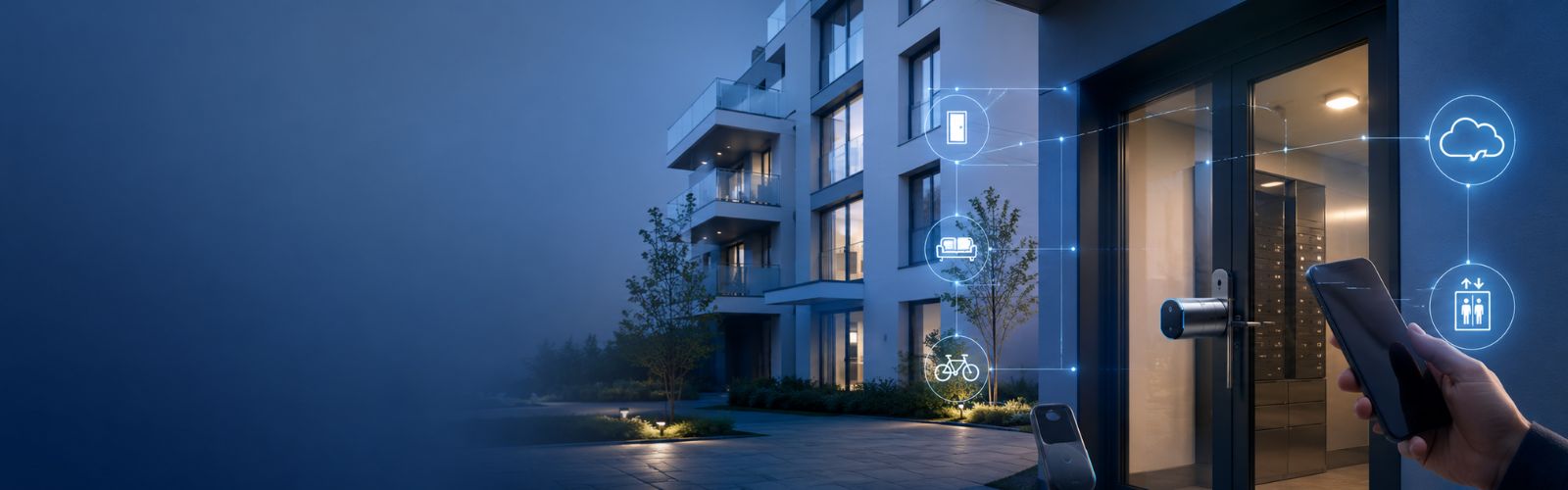
Locking System for Apartment Buildings: Costs, Law and Digital Alternatives
A locking system in an apartment building has to do many things at once: protect residents and property, control access to shared areas, adapt quickly when tenants change, and comply with property law, tenancy law and fire safety requirements. This article shows which system types exist, what they realistically cost, who is liable when a key is lost and when switching to a digital locking system pays off. BlueID delivers cloud-based access solutions Made in Germany, VDE-certified, with more than 10,000 active locks in operation.
Which locking system suits an apartment building?
For an apartment building, a central lock system or a digital locking system is usually the right choice. The decision depends on three factors: the number of units, the tenant turnover rate and the extent of shared areas.
- Up to 4 units with long-term tenants: a mechanical central lock system is usually sufficient
- From 6 units or with frequent tenant changes: a digital system amortizes within a few years
- With many shared areas (laundry, bicycle storage, garage): digital time windows deliver the biggest benefit
- For furnished or short-term rentals: a digital system is practically the only viable option
Doors and access zones in an apartment building
An average apartment building with 8 units has 14 to 18 doors integrated into the locking system. The overview shows which areas are typically included:
Locking system types compared
Instead of keys, transponders, chip cards or the smartphone are used in digital systems. Permissions are managed centrally via the cloud. The direct comparison:
How much does a locking system for an apartment building cost?
The cost of a locking system depends on the number of units, doors and the chosen security level. Realistic price ranges including installation:
The purchase price alone is misleading. What matters is the total cost of ownership over the typical 10-year lifespan. For a mechanical system with 8 units, realistic additions are: 2 lost keys with partial or full replacement, 6 to 10 tenant changes with cylinder swaps, key reorders and the administrative effort of the property manager. In total EUR 9,000 to 18,000. A digital system including software comes to around EUR 8,500 and amortizes after 3 to 5 years.
Configure your individual locking system for your apartment building now, free and without obligation.
Lost keys: who is liable?
A lost key is the single most expensive incident in an apartment building. Tenants have a duty of care for the keys handed to them and are generally liable for damages. Courts have limited this liability: a tenant does not automatically have to pay for the entire locking system, but usually only the proportional cost for the main entrance and their own apartment door. A full replacement is only justified when there is a concrete risk of misuse, for example when the key was lost together with the address. Private liability insurance covers the damage if the lost-key module is included in the policy.
Property law: resolutions and cost allocation
Replacing an existing locking system generally counts as proper administration and requires a simple majority at the owners' meeting. The main entrance, basement doors, laundry room and all other shared areas are common property; their costs are shared according to ownership shares. The apartment entrance door is a special case: the door leaf is private property, the frame and outer side are common property. With a central lock system, the apartment door cylinder is therefore usually procured collectively so the locking hierarchy stays consistent.
Tenancy law: spare keys, return and access
A landlord may not keep a spare key to the apartment without the tenant's explicit consent. This also applies to the property manager and caretaker. If a spare key is retained without consent, the tenant can demand a lock replacement at the landlord's expense. At the end of the tenancy, the tenant must return all keys, including self-made copies. With a digital system this dispute disappears: the permission is revoked on the move-out date, a forgotten transponder is worthless.
For contractors, meter readers and delivery services, a mechanical system requires handing over keys and hoping they come back. A digital system instead grants a time window, for example Tuesday 8 am to 12 pm. After expiry the permission lapses automatically and every access is logged.
Fire safety and escape routes
Locking the main entrance at night is generally not permitted because it blocks the escape route. Residents must be able to leave the building without a key in case of fire. The technical solution is a panic lock per EN 179 or EN 1125, which opens from the inside without a key while staying locked from the outside. BlueID door fittings and cylinders can be combined with panic functions.
Tenant change with a digital locking system
- Mechanical: collect keys, verify count, swap cylinder if any are missing, order new keys, document handover. Duration 1 to 3 weeks, cost EUR 150 to 400
- Digital: revoke the previous tenant's permission on the move-out date, create the new tenant's permission, issue a transponder or activate the app. Duration a few minutes, cost EUR 0 to 20
Retrofitting an apartment building
- Step 1: retrofit main entrance and basement door, all units benefit immediately
- Step 2: add shared rooms such as laundry, bicycle storage and waste room
- Step 3: integrate the parking garage and barrier control
- Step 4: convert apartment doors gradually at tenant changes, spreading the investment
The cylinder swap usually works without drilling or milling. The mechanical cylinder is removed, the electronic knob cylinder inserted. Mechanical and digital doors can run in parallel during the transition.
Purchasing criteria for property managers and owners
- Manage multiple properties from a single interface
- Role concept for manager, caretaker, owner and tenant with clearly separated rights
- Time windows for service providers that expire automatically
- Offline capability so doors open even during network outages
- Battery life of at least 2 years with timely warnings
- Panic function per EN 179 or EN 1125 for the main entrance
- GDPR-compliant logging with configurable retention periods
- Modular rollout so the investment can be spread over several years
- Made in Germany and VDE certification as a quality signal
Conclusion
A locking system in an apartment building is more than a technical decision. It touches property law, tenancy law, fire safety and insurance questions at the same time. Mechanical central lock systems are cheaper to buy but cause high follow-up costs at tenant changes and key losses. From around 6 units or with regular turnover, a digital system pays off within 3 to 5 years. With BlueID, property managers and owner associations get a cloud-based solution Made in Germany that can be retrofitted modularly and significantly reduces administrative effort.
Want to know what a locking system for your apartment building would cost? Configure your individual solution in just a few minutes.
Common questions about locking systems in apartment buildings
How much does a locking system for an apartment building cost?
A mechanical system costs EUR 600 to 1,200 for 4 units, EUR 900 to 2,500 for 8 units and EUR 1,400 to 3,500 for 12 units including installation. A digital BlueID system ranges from EUR 2,500 to 12,000 but amortizes over 3 to 5 years through eliminated cylinder replacements.
Who pays for the locking system in an apartment building?
In an owners' association, the community bears the costs for common property such as the main entrance and basement doors, allocated by ownership shares. In a rental building the owner pays. Costs caused by a tenant's lost key can be passed on to that tenant.
What happens if a tenant loses a key?
The tenant is generally liable for the damage, but only to the extent that a concrete risk of misuse exists. Courts often limit this to the proportional cost of the main entrance and the tenant's own apartment door. Private liability insurance covers the damage if the lost-key module is included.
Does the entire system always have to be replaced after a lost key?
No. A full replacement is only justified when there is a concrete risk of misuse, for example when the key was stolen together with the address. With anonymous loss, replacing the affected cylinder usually suffices. With a digital system the question disappears: the medium is blocked in seconds.
Does liability insurance cover lost keys?
Yes, provided the lost-key module is included in the policy. Check the coverage limit, as older contracts often cover only EUR 10,000. Whether professionally entrusted keys are included is also relevant.
What majority is needed for a resolution on a new locking system?
Replacing an existing system counts as proper administration and requires a simple majority. Since the German property law reform of 2020, a simple majority also suffices for structural changes. The resolution should specify the cost frame and implementation deadline.
May the landlord keep a spare key to the apartment?
No, not without the tenant's explicit consent. If the landlord retains a spare key without consent, the tenant can demand a lock replacement at the landlord's expense. This restriction does not apply to shared areas.
May the main entrance be locked at night?
Generally no, because it blocks the escape route. Courts have repeatedly invalidated such rules in house regulations. The technical solution is a panic lock per EN 179 or EN 1125, which opens from the inside without a key and stays locked from the outside.
Can a mechanical system be converted to digital?
Yes, in most cases without drilling or milling. The mechanical cylinder is removed and replaced with an electronic one. The conversion can be modular, starting with the main entrance and basement, later the apartment doors at tenant changes.
How does a tenant change work with a digital locking system?
The previous tenant's permission is revoked on the move-out date, and a new permission is created for the incoming tenant. This takes a few minutes and costs EUR 0 to 20 for a new medium. A forgotten or unreturned transponder is then worthless and no cylinder swap is needed.
So easy, hard to believe
With just a few clicks and seconds, users can be granted secure access.
Create a key


Accept the key
The recipient clicks on the link and the app automatically receives the key.
Open door


Fast Access Audit
With just a few clicks, you get a complete overview of events related to the key, the locks and the key holder.